Why Solana Wants Less Inflation, Faster
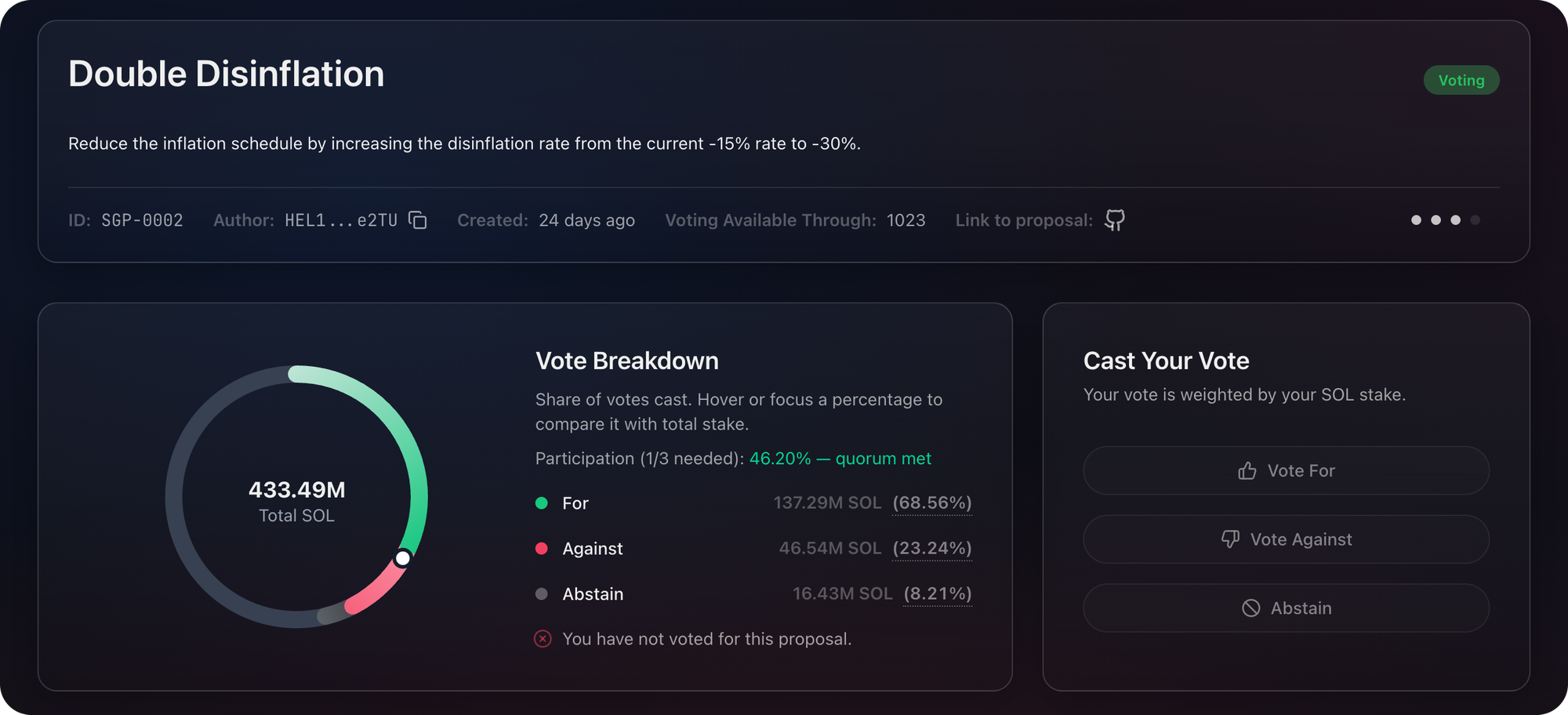
Solana's SGP-0002, which looks set to pass, would double the SOL disinflation rate and cut the path to 1.5% terminal inflation to under 3 years.


As of the time of writing, Solana looks set to pass its double-disinflation proposal (if by a slim margin) and, fittingly, SOL is up double digits over the past 24 hours amid the vote.
Solana will eventually reach a 1.5% inflation rate, an end goal that, at the network’s current pace, would take nearly six years to achieve. If SGP-0002 passes, that timeline will shrink to roughly 2.8 years as the annual disinflation rate doubles from 15% to 30%. The proposal does not change the 1.5% endpoint; it just gets Solana there faster.
Now why are they doing this?
Overall, right now, the two major proof-of-stake networks, Solana and Ethereum, are reconsidering whether their systems for ensuring economic security have them overpaying for it.
Economic security is, roughly, the amount of economic value committed to protecting a proof-of-stake network. The more stake controlled by honest validators, the more economic weight an attacker generally needs to disrupt or compromise consensus. Solana already has hundreds of millions of SOL staked, creating a substantial capital wall against attacks.
Issuing SOL to validators and stakers helps keep that security attractive, but both Solana and Ethereum have begun asking whether they need to pay as much as they currently do. Paying a lot makes sense when a network is young, as the network must incentivize people to participate. But now that Solana is much more mature, the question is whether issuance can taper faster without sacrificing meaningful security.
This isn’t the first time Solana has considered doing this. Last year, SIMD-0228 proposed a dynamic issuance system tied to staking participation. That vote actually saw massive 74% turnout, but only 61.4% of decisive votes supported it, short of the required two-thirds threshold, amid substantial debate over its complexity and effects on validators. This new proposal, SGP-0002, is much simpler, only accelerating the rate at which Solana reaches that final 1.5% rather than overhauling the system overall.
SGP-0002 has reached quorum! https://t.co/3p4wmL2mZY
— Tim Garcia (@TimGarcia0) August 27, 2026Enjoying this article?
Subscribe to Bankless or sign in
The case for it essentially comes down to three things:
- Stop Overpaying for Security. Solana needed (past tense) heavy issuance to bootstrap its validator network. The pro case is that, at its current maturity, additional issuance may now be buying less protection than it once did.
- Increase the "Money-ness" of SOL. Tapering down inflation makes SOL less dilutive and, in theory, a more attractive asset to hold and use as a store of value, one endgame many network assets strive to achieve. Stronger monetary credibility could also indirectly support economic security: if SOL retains more value, the dollar value securing the network can remain robust even with fewer SOL rewards.
- Stimulate DeFi. Higher issuance supports higher staking yields, which can disincentivize putting SOL to work in DeFi. Why take on smart-contract or liquidity risk for only a modest premium over staking? Lower staking yields reduce that hurdle, potentially pushing more SOL into DeFi venues that recycle capital through the ecosystem. The proposal’s authors explicitly cite this staking-versus-DeFi tradeoff.
But there are legitimate arguments against the proposal too, points which may sound familiar if you’ve been tracking the conversation around Ethereum’s EIP-8363.
- Squeezing Small Validators. Reducing rewards hits smaller validators hardest, who rely on every dollar they get from rewards. Modeling from the proposal’s authors suggests the faster schedule could push more validators into unprofitability sooner.
- Centralization Comes Next. The second-order effect of that squeeze could be stake migrating toward larger providers whose scale lets them weather the tightening, centralizing the validator set and potentially weakening economic security even if the headline amount of SOL staked remains high.
- Better Money Doesn’t Mean Better Prices. Reducing issuance tightens supply, but reducing supply does not inherently create demand. SOL could become less dilutive without becoming materially more valuable, leaving the network with lower staking incentives and little offsetting benefit. Personally, I find this the weakest argument considering the second-order effects of bolstering the money-ness of the token, though I guess we'll just have to see.
What’s interesting is that SGP-0002 also arrives alongside a sister proposal, SGP-0003, which also looks ready to pass and would further slow SOL’s supply growth from the other side. SGP-0002 reduces how much new SOL gets issued; SGP-0003 would increase how much SOL gets burned as the network is used. Specifically, it would replace the burned portion of Solana’s current flat transaction fee with a dynamic fee based on how much compute a transaction requests, with that fee burned entirely. Modeling based on recent network activity suggests that, at its final proposed rate, daily burns could increase from roughly 650 SOL today to 7,500–9,000 SOL.
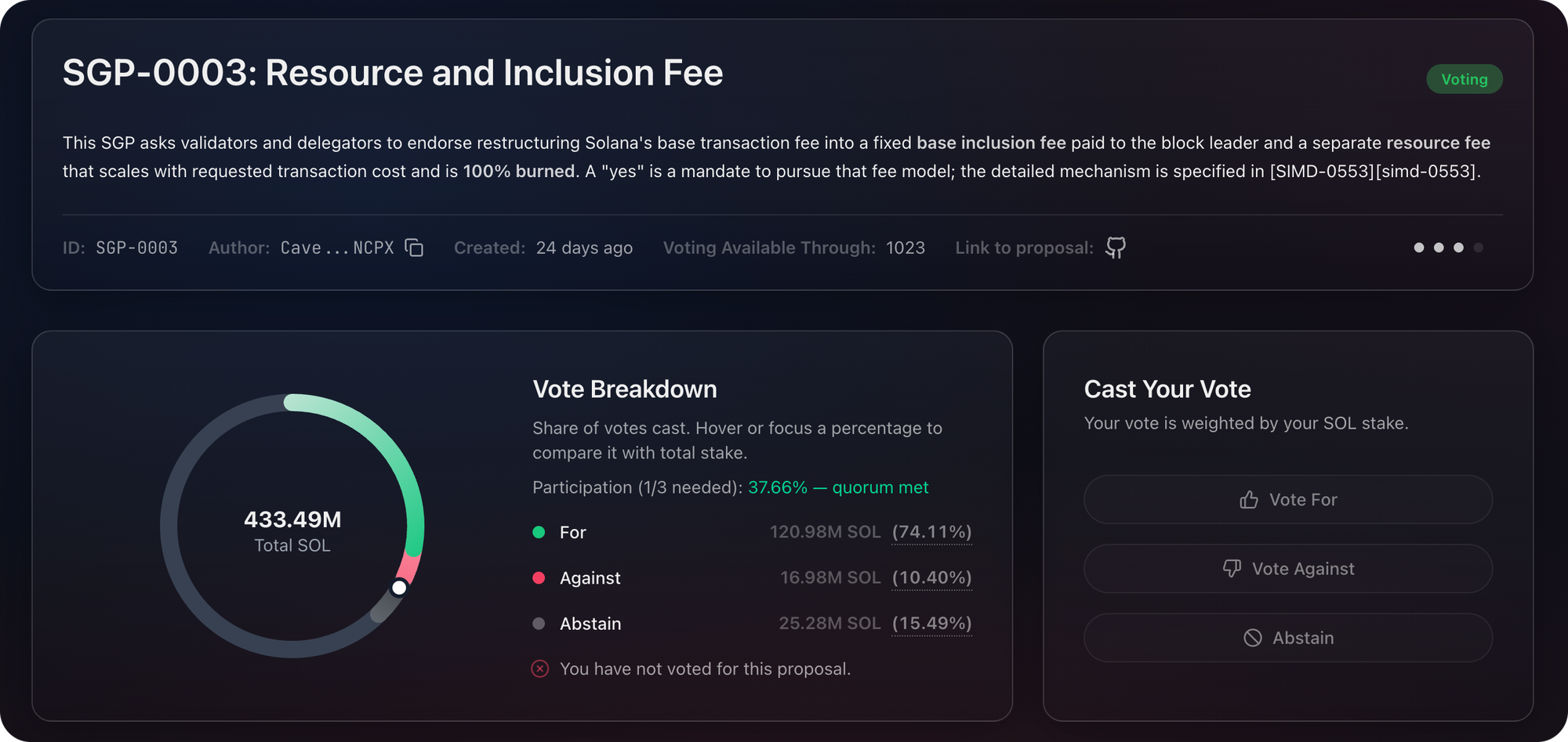
Put the two proposals together and the priority is obvious: slowing net supply growth, whether by issuing less SOL on one side or burning more SOL on the other.
What’s also cool about these proposals is that they’re among the first to come through Solana’s new onchain governance system, which launched in July, bringing delegators more directly into network-level decision-making. Anyone can draft a Solana Governance Proposal (SGP), though putting one onchain requires a validator with at least 100,000 SOL of active stake, and delegators can override their validator’s vote with their own stake.
Overall, we’ll have to see how the rest of voting plays out.
Even if it passes, though, nothing changes tomorrow. SGP-0002 is just the governance mandate; SIMD-0550 is the technical specification for actually making the change and still needs to be accepted, implemented by Solana’s clients, and activated. The authors’ modeling assumes roughly a 4.5-month lag before activation, rather than an immediate switch.
So Solana isn’t suddenly becoming a low-inflation asset overnight. If SGP-0002 passes, it’s deciding that, as a more mature network, it may no longer need to pay quite as much for the security it needs. Ethereum is wrestling with essentially the same question through a much more complicated mechanism. If Solana’s simpler approach works, I wouldn’t be surprised to see that debate echo elsewhere.
Exciting times, and it’s nice to see our kids (tokens) continue to grow.

David Christopher
David is a writer/analyst at Bankless. Prior to joining Bankless, he worked for a series of early-stage crypto startups and on grants from the Ethereum, Solana, and Urbit Foundations. He graduated from Skidmore College in New York. He currently lives in the Midwest and enjoys NFTs, but no longer participates in them.