5 Upgrades That Can Turn Zcash Into Private Cash at Scale
From faster blocks landing this week to private RPC payments still on the whiteboard, here's the roadmap Zcash's builders laid out on Bankless.

Scale remains the holy grail for privacy chains. Fortunately for the Zcash community, its builders have a plan to scale private ZEC payments. And better yet, the first step on that path lands this week.
In "The Complete Zcash Roadmap," the newest Bankless episode, Zcash cofounder Sean Bowe and protocol contributor Dev Ojha walked David Hoffman through how it’s possible to take Zcash from ~60 KB of throughput per second today toward Ojha's long-term goal of 50,000 transactions per second (i.e. 100 MB per second, a 166,500% climb in scaling!).
Today’s article will catch you up here by running through five of the upgrades that will be keystones for this vision.

1) Faster blocks
As I noted when the NU7 timeline was locked in back in September, Zcash's 9th major network upgrade will cut block times from 75 seconds to 25 seconds. NU7's activation height is set to land overnight Nov. 5th to 6th (UTC).
Since block sizes stay the same, this shift will roughly triple the chain's bandwidth to ~180 KB per second, per Ojha. From there, he pointed to tricks other chains already use, like erasure coding (i.e. splitting blocks into redundant chunks so nodes can rebuild them without downloading everything) and smarter gossip between nodes.
Notably, Zcash is doing all this while sticking with proof of work, too. Ojha hailed this as an effort to "make high throughput proof of work for the first time ever.” However, there’s a coming quirk to consider here: mining is random, so at 25-second averages, he said ~1% of blocks will land in about 250 milliseconds while another ~1% will take over 110 seconds.
Upgrade status: Faster blocks are slated to go live with NU7 this week. The tougher throughput work is what Ojha framed as the job "over the next two years."
2) PIR wallets
As Ojha put it, "The hard problem is, how do you figure out you got paid?"
With Zcash shielded addresses, nobody can see who paid who, so your wallet can't just ask a server for your balance. Instead, Zcash wallets have historically downloaded every transaction to check which ones were theirs, which would fall apart once the chain is pushing 100 MB per second.
Alas, cue in private information retrieval (PIR). Under this paradigm, your wallet would send an encrypted query to a server holding the chain data, and then the server would return the answer without ever learning what you asked thanks to homomorphic encryption (i.e. math performed directly on encrypted data).
Interestingly, AI is a big reason this system is now practical. Per Ojha, this kind of PIR boils down to giant matrix-vector multiplications, which is precisely the math GPUs have gotten cheap and fast at amid the ongoing AI boom.
In fairness, David pushed on the obvious concern that querying a server sounds like a trusted middleman. Ojha's answer was that PIR would work like RPCs do on Ethereum, where anyone can spin up their own provider and wallets can switch between many of them.
Upgrade status: Already in use! Bowe says Zcash used PIR in a recent coinholder vote, which he believes was a first for any crypto project.
3) Tachyon proof aggregation
Tachyon is the cryptography overhaul Bowe leads, and it specifically tackles two bottlenecks. The first is proofs, since today a full node checks every shielded transaction's zero-knowledge proof one by one.
Enjoying this article?
Subscribe to Bankless or sign in
Toward that end, Tachyon is developing recursive SNARKs (i.e. proofs that verify other proofs) to roll those up. This technique would flatten the responsibility of a full node to just verifying one rolled ZKP here and there instead of many standalone ones sequentially.
Notably, this system can deliver at least a 5x scaling improvement immediately upon being deployed, and if it sounds familiar, it’s because it is. David compared Tachyon’s proofs work to how ZK rollups bundle transactions on Ethereum, to which Ojha gave Ethereum credit for pioneering recursive proofs in production.
Upgrade status: In development. Tachyon code is being integrated into the cryptography stack behind the Zakura full node, but it hasn't been activated on mainnet, and there's no public launch date currently.
4) A stateless chain
Tachyon's second focus targets state bloat. Every time someone spends shielded ZEC, the network records a nullifier (i.e. a unique marker that stops the same funds from being spent twice), and unlike transparent chains, which can clear out old data, privacy chains need to keep that ever-growing list around.
Tachyon is working to compress that state, too. Per Ojha, full nodes would only keep roughly the last month of live state, while older history would become something you can query trustlessly when needed. Bowe credits the technique to a paper he co-wrote with cryptographer Ian Miers.
To be clear, Ojha was blunt that "you can't shove 50k TPS to a Raspberry Pi," but at that scale a node could only need a couple hundred gigabytes of storage instead of something like a petabyte.
Upgrade status: Currently in development as part of Tachyon.
5) Private RPC subscriptions
The last upgrade is more about economics, and it's also the earliest along of the bunch.
On Ethereum or Solana, wallet companies like MetaMask and Phantom pay for the RPC servers (i.e. the infrastructure that feeds your wallet chain data), in part because they can monetize users. Zcash doesn't track its users, so today a handful of providers serve that data for free.
To avoid "relying on altruism," Ojha has sketched a private subscription model. You'd prepay for, say, 1,000 requests a month, your wallet would turn that into one-time tokens, and each query would burn a token using the same double-spend-prevention tricks Zcash uses for payments.
As such, under this paradigm providers would be able to verify a valid subscription without knowing which subscriber is asking.
Upgrade status: Conceptual for now, though Ojha framed it as a problem that’s certainly solvable.
The road ahead
As for why this all matters now, Bowe's case was that AI has made it trivial to track people across transparent ledgers.
Beyond that intrigue, though, the new roadmap episode also gets into Zcash's post-quantum plans, formal verification, and governance, the last of which pairs nicely with my recent look at Zcash's dev fund debate.
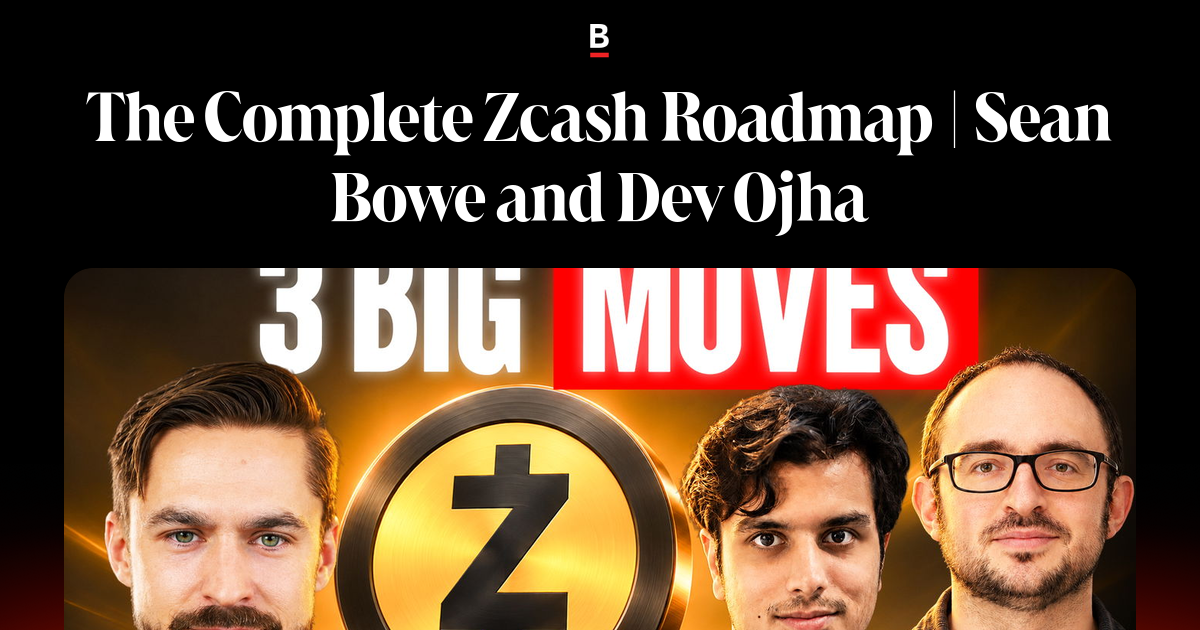
Be sure to give the full episode a listen if you want the complete picture, and keep your eyes peeled for NU7 this week!

William M. Peaster
William M. Peaster, Senior Writer, has been with Bankless since January 2021. Immersed in Ethereum since 2017, he covers the onchain frontier with a particular interest in art, games, and other culture apps. He has a background in creative writing and writes fiction in his free time.