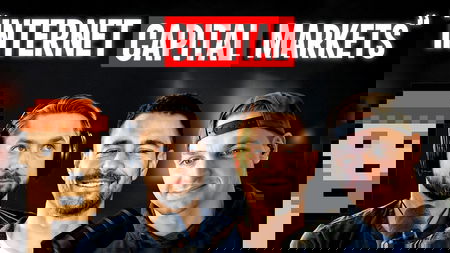
How ETH Wins | Ryan & David
A Call for ETH Maximalism, Nationalism & Pragmatism
Up next
All episodes 01:00:53
Podcast
01:00:53
Podcast
Launchcoin & Believe | ETH's 50% Candle | Coinbase Listed on S&P 500 | Jon, Bread, & Andy8052
 Podcast
LIMITLESS: This Is Far Bigger Than The Internet Boom | Shaun Maguire
 01:07:28
Podcast
01:07:28
Podcast
ROLLUP: ETH’s Pectra Upgrade | $2T Stablecoin Push | Apple’s Crypto Breakthrough | Coinbase Buys Deribit!
 01:20:56
Podcast
01:20:56
Podcast
AI Rollup: AI Robots and The $10T Arms Race
 01:20:40
Podcast
01:20:40
Podcast
Can PumpFun be Dethroned? ETH's Pectra Upgrade | Future of Bitcoin L2s | Jon, Bread, & Andy8052
 01:27:34
Podcast
01:27:34
Podcast
A New Chapter for Ethereum | EFs Co-EDs Tomasz & Hsiao-Wei
 01:02:56
Podcast
01:02:56
Podcast
Crypto's Big Test: Ethereum’s Pivot, Tariff Storms, and Bitcoin’s Political Rise
 01:28:21
Podcast
01:28:21
Podcast
AI ROLLUP: The AI Experiment That's Been Secretly Manipulating You
Inside the episode
Ethereum stands at a crossroads. Despite recent price surges and long-standing developer dominance, something deeper is missing—a unifying force to propel ETH into the future as not just a smart contract platform, but a true monetary asset. In this week’s special episode of Bankless Takes, Ryan and David sit down for a long-overdue sync and lay out complementary, and at times divergent, visions for how ETH wins.
A Call for ETH Maximalism
Ryan returns from hiatus with renewed conviction: Ethereum must embrace a memetic reawakening. His first pillar is ETH maximalism—not the toxic kind, but a belief-driven, unapologetic support for ETH the asset. Without ETH as a strong monetary foundation, there is no DeFi, no sovereign finance, no censorship-resistant property rights. He argues that ETH must be marketed, memed, and evangelized with the same fervor as Bitcoin—because it’s not just a utility token; it’s programmable digital gold with yield.
Ethereum’s culture, however, has been reluctant to embrace wealth creation or promote ETH’s price performance. Ryan challenges this aversion and reframes ETH’s value as integral to the ecosystem’s integrity. “A strong ETH means a strong Ethereum,” he insists.
Rebuilding Ethereum’s Product Stack
David counters not in disagreement, but with an orthogonal view: Ethereum must reorient its roadmap to restore the power and gravity of the Layer 1. His framework—a “Maslow’s hierarchy of Ethereum development”—places the L1 as the bedrock, with devs, apps, users, L2s, and finally ETH the asset stacked above it. Somewhere along the way, Ethereum skipped crucial steps by jumping straight to L2s, severing the feedback loops that once made it the undisputed economic hub of crypto.
David argues for scaling the L1, building out interop standards, and fostering base/native rollups that tightly integrate into Ethereum—not just technically, but economically. “Layer 2s today are like NATO allies—not fully aligned states,” he explains. To win, Ethereum needs a union—an “interstate” system where users, assets, and value move seamlessly.
Nationalism, Not Just Maximalism
In his second article, Ryan introduces the analogy of Ethereum as a network state. Drawing on American history, he likens the current Ethereum ecosystem to the U.S. under the Articles of Confederation: loosely affiliated, economically fragmented, and struggling to coordinate. The answer? A new Constitution—a unifying economic and governance protocol that binds L2s to the Ethereum state through shared incentives, currency (ETH), and purpose.
This nationalism, he clarifies, isn’t exclusionary—it’s about economic alignment. L2s should hold ETH in treasuries, settle in ETH, and contribute to its memetic and financial strength. Base and native rollups are the blueprint for this kind of alignment. “Every chain that chooses ETH should feel like it’s part of one indivisible republic,” Ryan says.
The Path Forward
Both Ryan and David converge on the idea that Ethereum’s winning move isn’t to copy Bitcoin, nor to compete in Solana’s speed race. It’s to lean into its uniqueness: a deeply programmable, censorship-resistant, economically vibrant base layer—and a native currency that reflects and amplifies that.
The strategy? Walk and chew gum. Talk about ETH the asset with pride. Scale Ethereum L1 aggressively. Pull devs, users, and liquidity back to the hub. And build the infrastructure and narratives that bind it all together.
Ethereum’s vision is still the most ambitious in crypto—and maybe even the most valuable. But it needs coordination, conviction, and clarity to reach it.
Transcript
Bankless Nation, welcome to a uh Bankless Takes. David, we haven't done one of these in a while, and we've got uh
In four months.
No Welcome back. It's uh thank you. Thank you. I while I was away, I was thinking a lot about Ethereum and this episode, I think.
Well, I was thinking about other things first, and then toward the end, I started thinking about Ethereum again. And
I don't think you'll ever not be thinking about Ethereum.
it seems that way.
Yeah.
I mean, it's embedded pretty deep at this point. And I had a few thoughts, some things to say as we're coming back. And I think that's the subject of today's episode, really what Ethereum needs to do. And I've got some takes. And I think I feel like you and I have different lenses on some of the problemslash solutions for Ethereum. I think my lens, if I were to like throw through, throw something out there, my lens is more mimetic. Right. So like my focus and aperture is like, hey, what memes and what social layer changes around those memes does the Ethereum community need to adopt moving forward? Your take, if I understand your your article, is a bit more product lens focused. Yes. So you're like a bit more roadmap and the things to prioritize if Ethereum is to reorient and start thinking about a product led roadmap versus whatever it has been doing previously. So I think we're bringing two different lenses into this conversation.
Yeah. Maybe to I the so you've you took your three months hiatus. You've come back two weeks ago, three weeks ago. Yeah. And I think like during that time, you and I have not like we had one month check-ins. But yeah, we went like one month at a time without checking in. It was real cold turkey. Real cold turkey. And so for the first time ever since like starting Bankless, and even before Bankless, you and I have had the opportunity to like think about Ethereum without bouncing ideas off of each other.
Haven't synced the nodes.
Exactly. Yeah. So I think this episode is kind of like a node sync between us about our current takes of Ethereum. But I also kind of appreciate the time of like what does it look like for like David and Ryan respectively to like come to their own conclusions about Ethereum while they aren't always like sharing such a strong brain space that we've always shared. Right. And like I think our
Our attention attention focuses have diverged. I don't think we have divergent opinions, but we have just simply focused on different things. And I think that has become apparent as you come back and you have three articles that you've written. I have one article that is going live on the newsletter tomorrow from the day of recording. And so yeah, we get to kind of like put these two things together and see what meshes and what doesn't mesh.
Yeah, I think that's what's cool. And so maybe th that's going to be the structure of today's episode. Basically well, what's really interesting is just last week, this is kind of current events, ETH was up forty-four percent in like a seventy-two hour current time.
Honestly incredible.
This is like the largest gain since like 2021, since like it jumped from 200 to like, you know, s you know something a lot higher in that era. So
Interesting that no one really knows why.
that's what's funny to me, right? Is it caught a lot of people off sides. Of course, these bulls were like, Oh, we told you so. Like I was among them. Yeah.
Yeah.
Yeah.
Nothing ever wrong in the first place.
Well, see, that last piece is kind of the the danger spot, I think. Because it's very much for me, you know, I was sharing that uh that Kobe a big sports guy, I was sharing that Kobe Bryant meme to use like job not finished. Honestly,
Somebody asked it's like a meme, right? It's like somebody asked him during playoffs or something. I don't know, bit basketball fans get this right, but like, hey, like he had a really good game. Like, aren't you excited about your game or whatever? He's like, so like, why would I be excited? Job's not finished. And I feel like that is true for Ethereum right now.
Right.
We got 44% last week. Let's not rest on our laurels.
We are still at point zero two for ETHBTC.
Job's not finished.
We have just barely gotten started.
Okay. So this, in our opinions, I think, uh like mine and then also yours, is what Ethereum needs to do to like finish the job. And I think that's the context for today's episode.
Maybe we could also define what we think a finished job looks like too. So like what what are the outcomes that we're going for?
Yeah. I guess I mean, by way of preambles, a few things I'll say. It's like maybe the first thing for me, I mean, we've talked about my first love. I think your first love. I mean, like, I had Bitcoin before this, but it was really Ethereum that kind of like sent me down the crypto rabbit hole. And it's because of this holistic idea of programmable internet money, this DeFi economy, all emanating from a programmable smart contract platform. So I think what's the goal? What's the end state? For me, this comes from a position of love. Like very much, I want ETH to win.
Like emphatically, like I truly do because I want that complete vision for a bankless money system to win. And Bitcoin has pieces of it, right? But if you look at it, doesn't have the programmability part. If you look at all of the activity that's happening, it's happening off chain in like, you know, Michael Saylor accounts and with you know custodied Bitcoin tokens, IOUs, essentially. It's not the full vision of DeFi that we were promised. And then you have alternative layer ones.
That makes some big centralization sacrifices because I don't think they're going for the state, the nation state resistant sovereign money thing. Right. And so, from my perspective, what do I want for Ethereum? Like what Ethereum needs to do, what Ethereum needs to do to win, essentially, is where I'm coming from.
Yeah. I think the way that I would articulate this is that
If Ethereum does all of the things that I think it needs to do, and if it has the successful outcomes that we want it to have, ETH will be downstream of that, a sitting shoulder to shoulder with Bitcoin as the second money to emerge out of crypto. And so I don't consider like the flippining to be like the KPI, the metric, the goal of success here, because I don't think like to me that that kind of includes like the demise of Bitcoin, partly inside of like the success of Ethereum. And I don't think that needs to be the case. What I think looks like success is that the Ethereum product stack, in my article, we're going to talk about like this like Maslow's hierarchy of product development and like ETH is money, and ETH is like a non-sovereign store of value that's sitting shoulder to shoulder with Bitcoin is downstream of a very coherent, very successful product stack. And so to me, successful, a job well done, a finished job is that there are two crypto monies out there valued by the market, and that's Bitcoin and Ethereum. And like there's kind of like there's no nothing else. We have the digital gold, and then we have this digital economy money. And those are the two valid contenders for internet money. That's what success looks like to me.
Strong Ethereum network, strong ether, the asset, both of those things. I think we're in full agreement on that. Well, it's uh a lot of preamble. Maybe we should uh get to it, but before we do, we want to thank the sponsors.
So when Ryan Sean Adams comes back from his three-month highs, he immediately starts powering out a bunch of articles on Twitter. One is called The Blue Money Gospel. The second, Towards a United Chains of Ethereum. And third, three, ETH commodity money backed by an economy. And so Ryan just comes in with a force. And really, I think you're sharing your thoughts. You're dumping your thoughts on Twitter. How do you want to proceed through these things? Is there an order of operations here? Where should we start?
Yeah, I want to start with like three calls that I'm making. Really, the first is a call for maximalism.
Mm-hmm.
I'm just gonna let that word just just linger in the air because I think a lot of people in the Ethereum community hearing the M word are immediately triggered, and that is intentional. I want you to be triggered. This is a call for ETH maximalism. So I'll talk about that. It's also a call for nationalism, both ether nationalism and Ethereum nationalism. And finally, it's a it's a call for a change of the narrative. All right. So there's really three calls to action. And one thing I'll say before getting into like my takes here is one, this is very much for the Ethereum community. Like it's for us. Okay. Right. So like this is not the episode to go send your Trad Fi friends to explain like what is Ether the asset necessarily. This, what the work that I am trying to do, and I think you were trying to do in your article, is internal. It's basically what we would call layer zero, you know, the social layer that underlines all of these social technologies that are blocked. It's that kind of work, it's memetic work.
House straight.
Yes. And of course, these are our opinions. This is bankless takes. So it's just like we're not the only people in the Ethereum community. But we've been here for a while. We've seen a few things, and our takes are based on that. So these are musings meant for the Ethereum communities, not outsiders. And this is like, this is not technical work. This is layer zero mimetic core dev work, if you will. So that by way of preamble. So maybe I'll just start with the first article I released, which I called the blue money gospel. And this is really the call for maximalism, David. Now, when I say the M word, maximalism, okay, what what does that trigger in you? Just the context. Or what do you think that triggers in the average sort of Ethereum community member?
Yeah, I think there's a negative connotation of like toxicity and closed-mindedness and being mean on Twitter. Like these are, I think, the first like
Like a laser eyed ma like
emotional reactions that I think people have to the word.
Yeah. Is that your reaction or do you see also a positive side of that?
Yeah, I definitely see the positive side of it. It takes a little bit more cognitive work to see the positive side of that. But if I were to articulate the positive side of that, it is being like unrelenting, having an unrelenting focus and support of like a particular asset and like espousing the positives of an asset and as like as it deserves to carve out this niche in the market.
Okay, so here's my case for why blue money gospel and why ether the asset maximalism, not necessarily Ethereum the network maximalism. And it begins like this in order to win, Ethereum has to embrace the Blue Money Gospel. And that means ETH is good. ETH to $10 trillion is good for the world. Without ETH, the asset, there is no DeFi. Without ETH, the asset, there are no cyberpunk values. Ethereum will never be a strong Ethereum without a strong ether. And so here's the problem, David. I am laying that out and putting that out in like very bold ways. I feel like the Ethereum community has been very weak in talking and presenting and evangelizing the value of this programmable, censorship-resistant monetary system, this money that lies at the heart of everything that we've created in this network. And that is Ether the asset. Okay. We spend all our time on Ethereum the network, talking about bringing other people's assets on chain and you'll like stable coins and real world assets and layer twos, all these things. And that's great. But that's only one half of making this economic system successful. The other half is Ether the asset. And we spend almost no time evangelizing and talking about the value of Ether the asset. And I would go further, David. I feel like embedded somewhere in Ethereum culture is this.
The this hesitancy,
Yeah, the resistance towards like the money or the value of the currency.
it's almost like a wealth aversion type thing. Like, okay, number go up, like bags go up. That's dirty stuff. Like we're better than that.
Right.
Right. And what I'm saying is
We're not better than that.
we're not better than that. And actually that is a good outcome in itself. Is because when Ether, the asset goes up, DeFi goes up. In fact
The strong case of that is it's the only way we can possibly create DeFi and not be overrun by somebody else's asset, some form of tokenized Bitcoin on Ethereum in our layer twos, some sort of stablecoin. We don't have actual sovereignty over our network unless we have a strong multi trillion dollar, tens of trillion dollar ether the asset. And we should not be ashamed about that. Okay. In fact, we should be like Bitcoiners. So here's something that Bitcoin got right.
Orange coin, number go up, 21 million. It's not supply for them. It's scripture. Okay? They've they've turned it into a religion. Like we've been in crypto long enough to actually see this, right? People used to laugh about this stuff. And now they're talking about Bitcoin on the treasury of the United States of America in a permanent way. Like they did the hard thing and they did it on the social layer. They did it through evangelism. How many network upgrades have you seen from Bitcoin over the years? Like,
Two
they don't talk about their network. Right. Okay? They all sing one hymn, and that is Bitcoin is a store of value. It's money.
Bitcoin fixes this.
And what did they do? They turned it into a $2 trillion decentralized store of value asset. Right? Like, how magic is that? And they did it through the propagation of like what I call a gospel, a religion. If you're not comfortable with that, it's a social consensus, right? It's it's it's incredibly powerful. And I think what Ethereum forgot is even if you build the best settlement engine on Earth and you build the best network.

David Hoffman
Co-owner at Bankless. Optimistic storyteller of frontier technology.