$30k BTC & Beyond? BlackRock Bitcoin ETF with Austin Campbell
What will a Bitcoin ETF do to the price of Bitcoin?


Up next
All episodes 00:59:10
Podcast
00:59:10
Podcast
Zora Announces The Zora Network
 01:25:04
Podcast
01:25:04
Podcast
ROLLUP: Prometheum SEC Psyop Exposed
 00:20:38
Podcast Premium
00:20:38
Podcast Premium
DEBRIEF - What is Money in the Digital Age?
 01:20:20
DeFi
01:20:20
DeFi
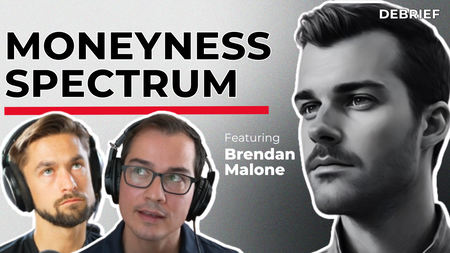
176 - What is Money in the Digital Age? with Brendan Malone
 01:33:39
DeFi
01:33:39
DeFi
Announcing Uniswap V4 With Hayden Adams
 01:18:42
Podcast
01:18:42
Podcast
175 - 400M PayPal Users to Crypto with Jose Fernandez da Ponte
 00:22:36
Podcast Premium
00:22:36
Podcast Premium
DEBRIEF - 400M PayPal Users to Crypto
 Ethereum
Gary And The SEC Will Not Defeat Crypto
Inside the episode
Austin Campbell is the managing partner of Zero Knowledge Consulting, an adjunct professor at Columbia Business School, and used to work at Paxos as both Portfolio Management and Chief Risk Officer. He also was Co-Head of Digital Assets in Global Rates at CitiBank at JP Morgan for a decade. Austin knows a thing or two about the TradWorld and we brought him on to help us navigate all of the TradNews that has surfaced in the last two weeks around the crypto space.
TIMESTAMPS:
0:00 Intro
5:12 Austin Campbell
7:14 TradFi Last Two Weeks
10:59 Political Conspiracy
15:05 Timing Analysis
17:17 BlackRock Bitcoin ETF
20:05 Other Bitcoin ETFs Denied
22:47 What's the SEC's Next Move?
24:00 How Bullish is This?
26:13 BlackRock & Coinbase/Kraken Partnership
31:15 EDX Markets
37:22 Unbundling of Crypto Exchanges
42:22 Stablecoins Landscape
49:55 Stablecoin McHenry Bill
56:50 International Stablecoins
57:55 Closing & Disclosures
RESOURCES:
Austin Campbell
https://twitter.com/CampbellJAustin
Transcript
Banks Nation, it's TradFi season. The BlackRock, the with $10 trillion of AUM, the biggest asset manager, I think, in the United States, has submitted an application for a Bitcoin ETF. Is it gonna get approved? How bullish is it? What does this mean for the SEC's treatment of crypto? But not only that, Charles Schwab and Fidelity have a new uh exchange entering into the marketplace. The EDX Markets Exchange has entered the fold. Who is this marketplace for? How is it different? And what is with the timing of all of this? In the worst, most hostile regulatory environment, some of the biggest traditional players have decided to enter the game. What is the deal with that? There's also a bunch of stablecoin conversations to be had as well. Stable coins are under attack, some of them are being labeled as securities, yet, also there is a stablecoin bill going through Congress. What why is this all happening at once? These are some very deep, very big questions about the way that the incumbents of the world are treating our industry, and they're also treating it well. They want to come play the game. The TradFi conversation is definitely a conversation that I need help with. So we are bringing on someone who has been in the TradFi world. Austin Campbell, uh new to the Bankless podcast, is going to help us navigate some of these conversations. And I will introduce him in just a second. But first, a moment to talk about some of these fantastic sponsors that make the show possible, especially Bankless Nation. I would love to introduce you to Austin Campbell. Austin is the managing partner of Zero Knowledge Consulting. He's also an adjunct professor at Columbia Business School. He used to work at Paxos, the stablecoin issuer in both portfolio management and also as the chief risk officer. He was once the co head of digital assets and global rates at Citibank and was also at JP Morgan for over a decade. So Austin knows a thing or two about the trad world. And I'm hoping he can help us navigate all of the trad news that has surfaced in the last two weeks or so around the crypto space. Austin, welcome to Bankless.
Yeah, thank you for having me, David.
Uh so that was my attempt at your bio, but maybe you want to uh explore a little bit. This is uh your your first uh first appearance on Banklist, so w welcome to the show, but also just a little bit more about who Austin Campbell is and and where your where your position is in the crypto world.
Yeah, so I would say, you know, I jokingly describe myself as ultimately a uh person who wandered into crypto despite being a grouchy fixed income person from traditional finance. So, like my background in that space.
So I I started my mainstream career in traditional finance after some time in reinsurance, it was largely around cash stability products.
So I was thinking about, you know, and this is going to sound familiar to people who have thought about stable coins. If I've got this underlying pool of assets,
And I always need them to trade at a fixed price, despite people coming in and out of this pool. How would I make that happen?
And the areas in which I was originally working on that were actually in very traditional markets of the US. So it was bank capital markets and then the 401k market.
So if anybody has ever looked in their 401k, if you're a US person and seen a stable value fund, that you can blame me,
right? Among many other people for making those things happen.
So I did that for a long time and got interested in crypto.
You know, really because of some of the issues around 2008 and how some of the innovations of blockchain technology and the financial structure that underpins that solve a lot of the problems that we had.
That really, you know, I don't have to preach that 2008 was incredibly destructive to people.
So I didn't come at it from like call it an ideological maximalism standpoint. I was very much a functionalist and like, hey, this solves problems.
And so from there, I was at Stonerge for a while. That's the parent of Nidig. I was through City, I was at Paxos for a while. And now I do a lot of consulting work in this space.
Beautiful, beautiful. And I think you are the perfect man to really help us uh guide us through this conversation. As I said in the intro, uh the trad world is not something that I'm familiar with. So I definitely need help here. Uh bankless listeners will know that I learned everything I know about money and finance through crypto, not through anything uh prior to crypto. I want to start with this tweet that came from Delphi Digital, which just says over the past two weeks,
BlackRock files for a Bitcoin ETF, NASDAQ has launching crypto custody services, Deutsch Bank seeks crypto custody services. Soros fund management says crypto is here to stay. Citadel Fidelity and Charles Schwab launch a crypto exchange. The institutions are here. Now, not all of this has happened in the last two weeks. Nasdaq has been doing their custody thing for a long while now. But I think the the point still stands, and what this tweet's really getting at is like, man, in the last two weeks, TradFi has entered the game in a very new and very big way.
And in over the series of that's been a year of just onslaught from regulators and governments and just uh also onslaught from Trad leaders like Jamie Diamond, uh Larry Fink, all these people, all of a sudden trad trad is entering the game. So from and that's what it that's what it feels like to me as a crypto native, somebody who lives and breathes inside of the industry. I don't know what it looks like for the perspective of someone who is also extremely familiar with the trad world. So can you maybe you could just like summarize the sentiment of someone who is both familiar with crypto and traditional finance? Like, what does the last two weeks mean to you?
So I would say anytime something like this happens in a traditional financial firm and you see things come together over about a two week period, that's probably the culmination of six to 18 months of work behind the scenes.
Everything moves slowly at these places, right? So, like if you're at a crypto startup, if you live in the crypto world,
you're used to making decisions by getting together on Telegram or, you know, maybe getting on a video call, arguing with each other.
If it's a long one, doing some research, coming back and doing it again a few days later.
I launched a product at
City that took a year and a half to make that kind of decision. Right. So the timescales you operate on are just glacial
compared to what you're going to see in the regular world. So if BlackRock filed an ETF application, they've been thinking about it for a while.
Part of it is just why do they pick the current moment?
And I would say
it's important to remember the history there. If you look at ETF applications for Bitcoin ETFs, there have been many of them.
From genuinely some pretty top rate institutions, right? You've got like Fidelity, you've got Invesco, you've got Van Eck, you've got Stone Ridge, my old employer.
All people who live well within the regulated world, the SEC is familiar with. They're not engaging in funny business. Like these are genuine attempts at ETFs.
So what's the signal for BlackRock piling on?
I would say it's two things. One, it's telling the SEC and the US government if we can't get our act together here, there's a lot of things that are already happening offshore. Like these products exist in Canada, they exist in Europe.
And if you block us here, we're probably just going to take our business there as part of the message.
Another thing is that Larry think is pretty influential in the Democratic Party. I think
this may be a little bit of a signal from the TradFi world
we would like you to find a constructive solution to this problem, not just keep blocking it.
Because when you look
and zoom out from the US and think about the global
Like situation. You have Project Guardian coming out of Singapore, the JFSA in Japan has been very progressive on crypto and also very protective of consumers.
Like FTX Japan didn't lose anybody's money. And I think a lot of people don't realize this.
Mika just passed in Europe. So I think U.S. traditional financial firms are genuinely at the point of being very worried about being left behind.
And that's part of the reason you're seeing these things coming forward because you got to put the pressure on. If we wait another six years, you're,
you know.
In crypto terms, that's like what, eight market cycles at this point?
Yeah, certainly. And so there's a sentiment out there that.
Uh in crypto, we like to wear our conspiracy hats. Sometimes I think it's pretty fun to put it on. And the the conspiracy here is that uh the Democratic Party specifically, the Biden administration, along with Gary Gensler, you know, Elizabeth Warren, that whole access of power, has been hammering all of the crypto native companies and the crypto native industry
in order to clear the way for you know the Larry Finks, right? You said like the Larry Fink is very influential in the Democratic Party. So the the conspiracy is that you know the the regulators have been acting as an arm of the Democrats in order to clear the way for the big traditional incumbents in order to have free and easy access into a market that the regulators have hammered.
How on a scale, uh how how much merit does this sentiment have, or is this just crypto people being conspiracy people?
So
there's a great scene in the movie Forr Gump, if anybody's seen it, where Forrest is playing football, catches the ball,
runs down the field, scores a touchdown, and then runs out of the stadium and continues running basically forever.
That's kind of what the crypto community does to me with a lot of these conspiracy theories, right? It's like you take an initial grain of truth, but then you're like out the stadium and across the country.
So what I would say is this
yes, regulators have hammered a lot of
Crypto firms. However, I would say
there's two things going on there simultaneously. I would not find this like a great plot to empower TradFi. It's that one, just being blunt, some of our regulators are really uninformed on this technology or underinformed
and don't have a complete view of what's going on in the market, why the technology is important, why it should be used, what's progressive. Like there are people in the administration
and at some of the regulators who just think all of crypto is a scam. And if it all leaves the country, that's a feature, not a bug.
On the other hand, there are many people at these regulators and within the administration within the Democratic Party who don't hold that view. So don't take that as a monolith.
Understand that as you describe, quote, the Democratic Party, that's kind of describing like, quote, half the United States.

David Hoffman
Co-owner at Bankless. Optimistic storyteller of frontier technology.
.png-cde5b9c0aa4838d09c634abbd1136ff2.png)
.jpg-18135fa8a6782445ade4b56c7dcd5184.jpg)
.png-a616dc52961c1edd72b0c1fdf5f47e7a.png)